
TRAINING TECHNIQUES MATRIX
The trainer's postures
Regarding the teaching methodologies used in the training, we are embarrassed to choose between an unwavering group exercise or a more challenging role play, a quiet lecture or an engaging team building. How to choose then? Which will be better for our client? We thought we'd group together the best-known techniques and most functional approaches to make it easier to choose.
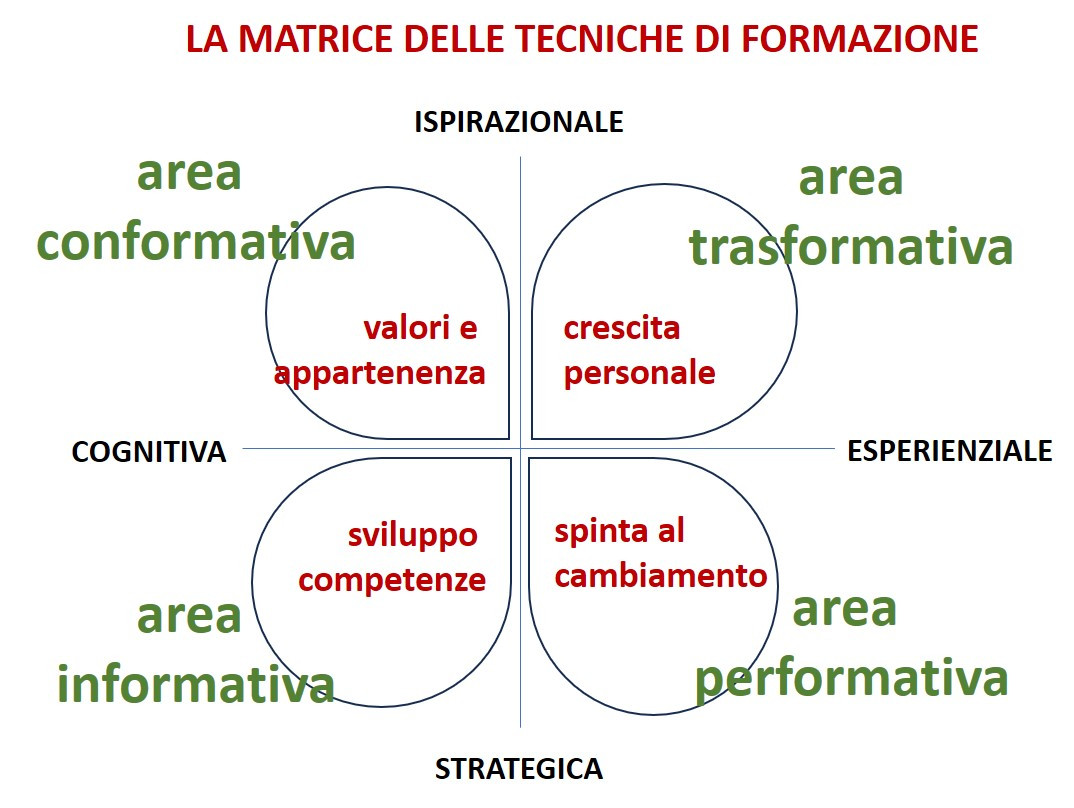
The matrix of training techniques born from experience and comparison with experienced trainers wants to respond to this. The grouping of techniques is therefore inevitably the result of a subjective evaluation. We built the matrix around two axes: the first considers the approach used, from the predominantly theoretical and cognitive one to the more concrete and experiential one. Instead, the second axis takes account of the overriding intention of training: to develop a strategic attitude or to nurture a more inspired vision? The four areas generated around the two axes highlight the meaning of the training adopted. If we associate the cognitive approach with a strategic objective, training will have a predominantly “informative” focus, that is, it prioritizes the transfer of information, knowledge, and tools. Instead, by crossing the cognitive approach with an inspirational intent, an area emerges that we have defined as “conformative” given that the training in that case has the aim of pushing people to adapt and conform to values and to feel part of the company.
Similarly, if we consider the intersection of the two axes, inspirational and experiential, a “transformative” area emerges that is precisely the purpose of that type of training, oriented towards personal growth, self-discovery, and the transformation of profound meanings. Finally, the last quadrant combines an experiential approach with a strategic purpose; it is the “performative” area where training carried out mainly through exercises aims to train people to adopt new, higher-performing behaviors and modify their strategies. The purpose of these groupings is essentially practical and is intended to clarify the tools that the trainer uses as a function of the client's objectives and the methodological approach in the training. These four areas also influence the trainer's posture and style in the classroom.
In the matrix we can now introduce the different techniques used. The inclusion of a technique in one or more quadrants follows the obviously subjective criterion of prevalence. The same technique can in fact be placed in multiple quadrants, for example a team building can be located in the “ conformative” area when the main objective of the training is to develop belonging, it can be located in the “performative” area if the prevailing goal is behavioral change.
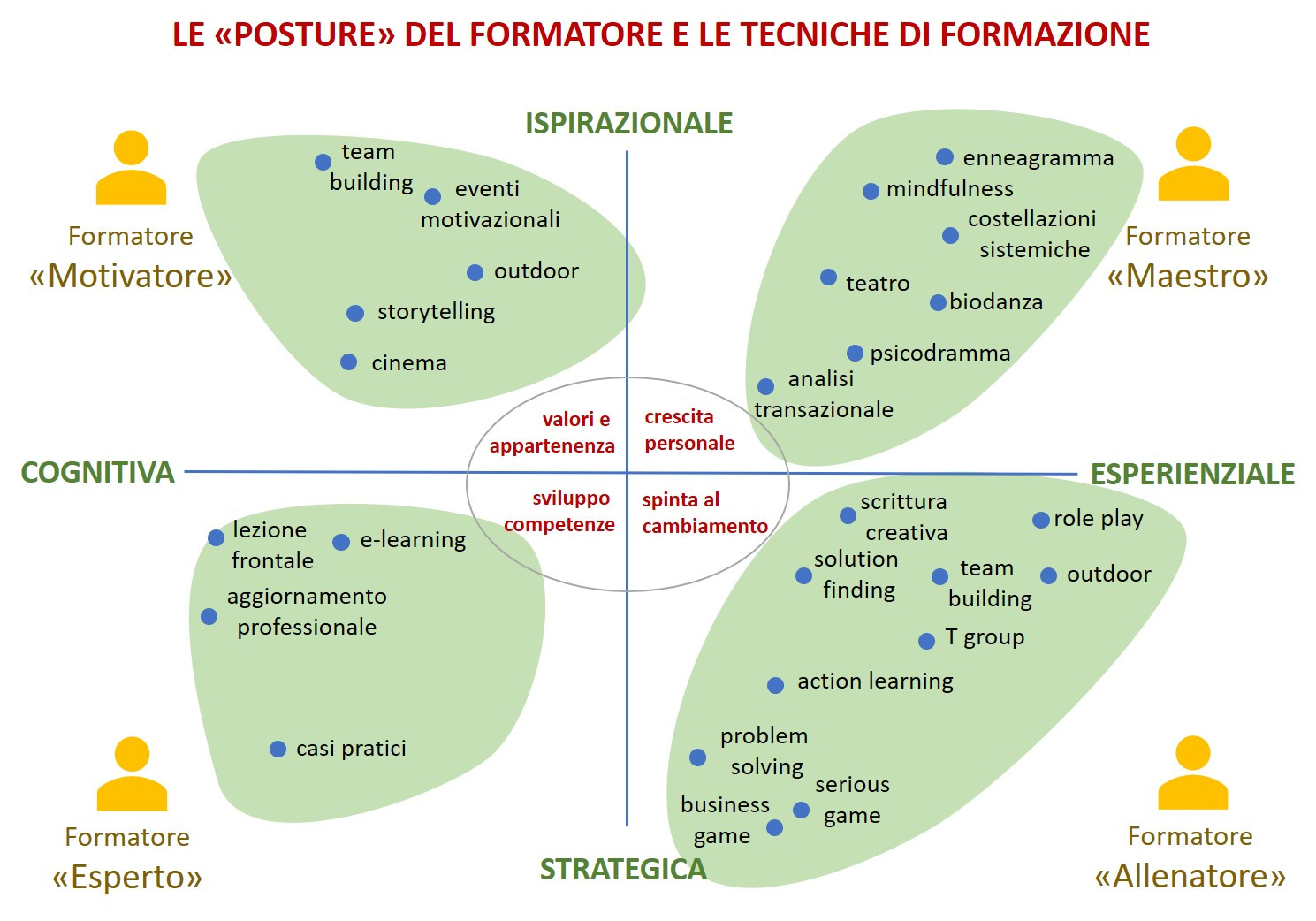
The “matrix of training techniques” illustrates the “different postures” that the trainer assumes in relation to the types of training adopted. In the first quadrant at the bottom left, in the information area (skills development) the trainer in the classroom is usually required to have an attitude that we define as “expert”, a posture that conveys confidence, competence, mastery of which he explains. In the second quadrant, in the conformational area (values and belonging), the trainer must be able to persuade and engage people to embrace and live the company's values, to feel part of the company, of the group. He must therefore be a good “motivator”. In the third quadrant, in the transformative area (personal growth), people are looking for individual answers to understand themselves and the profound meaning of their experience, and there is a need for a trainer who is a “master” of life in whom to place full trust and to whom to rely. Finally, the posture required of the trainer in the fourth quadrant is completely different, in the performance area (driven to change) that works with people to improve their performances, modify their behaviors, and strategies. Here we need a “coach” who knows how to hire and make the group work, it is no coincidence that we are talking about training gyms here. The trainer coach, unlike the others, usually does not possess any particular characteristics. You only recognize it when, in the classroom, you have the group work with exercises, feedback, repetitions, just like in the gym, tireless and always focused on the content.
Faced with the widespread diffusion of distance learning and digital learning, a further posture is developing: that of the “actor-trainer” most akin to the entertainer, capable of coordinating a technical team, using digital tools, choosing tempos, rhythms, and shots, and setting up sets and soundtracks: in-person learning is therefore transforming into edutainment.
 English (UK)
  Italiano